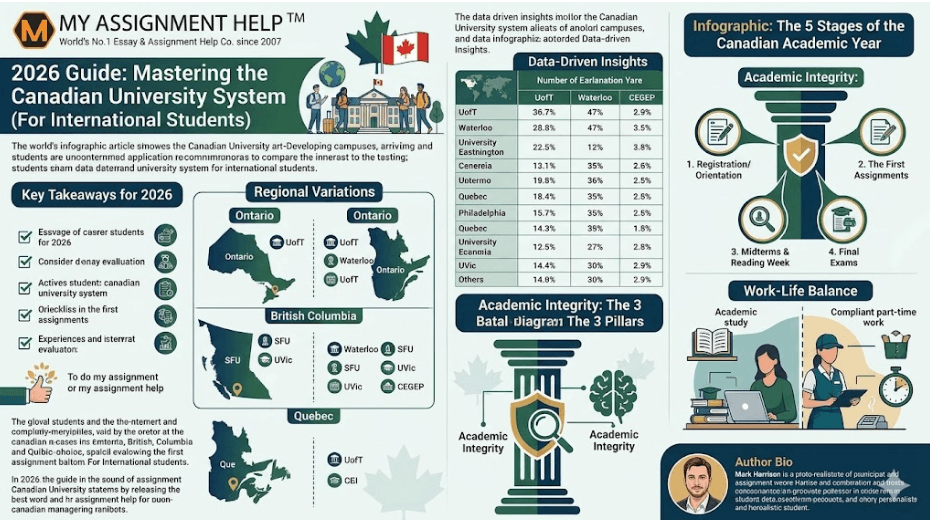
Canada remains a global titan in higher education, hosting over 800,000 international students at various Designated Learning Institutions (DLIs). However, the “Great White North” offers more than just scenic campuses; it presents a rigorous, multifaceted academic culture that can be a shock to those accustomed to lecture-only systems. To truly master this landscape, students must look beyond the brochure and understand the mechanics of local grading, regional differences, and the strict codes of conduct that govern Canadian halls of higher learning.
Transitioning to a new country involves a steep learning curve. Many students find that professional academic auditing or assignment consultation helps them bridge the gap between their home country’s writing style and Canadian standards. This proactive approach allows learners to do my assignment in Canada with a focus on structural integrity and localized tone, ensuring their initial submissions meet the specific expectations of Canadian faculty.
Furthermore, as students look toward global career paths, they often balance their local Canadian studies with international certifications. For those aiming for the UK corporate sector or multinational firms, seeking specialized hr assignment help can provide a competitive edge in understanding global labor relations while maintaining their focus on local GPA requirements.
Key Takeaways for 2026
- DLI Verification: Always ensure your school is a Designated Learning Institution to remain eligible for the Post-Graduation Work Permit (PGWP).
- GPA Variations: Be aware that a 4.0 scale in Ontario differs from the 4.33 scale used in provinces like British Columbia.
- The “Syllabus” is Law: Your Course Outline is a binding contract; deadlines are rarely flexible.
- Academic Integrity: The Academic Integrity Office in most universities uses AI-detection and plagiarism software as standard practice.
Regional Variations: Ontario vs. British Columbia vs. Quebec
Canada’s education system is decentralized, meaning provinces set their own standards.
The GPA Divide
In Ontario (home to UofT and Waterloo), most universities stick to a standard 4.0 GPA scale. However, if you move west to British Columbia, institutions like Simon Fraser University (SFU) or the University of Victoria (UVic) often utilize a 4.33 scale. Understanding this is vital when calculating your honors standing or applying for graduate school.
The Quebec Factor
In Quebec, the system includes a unique step called CEGEP (Collège d’enseignement général et professionnel) between high school and university. International students entering Quebec must also obtain a CAQ (Certificat d’acceptation du Québec) in addition to their federal study permit.
2. Navigating the Syllabus and Course Outline
In many cultures, the syllabus is a vague guide. In Canada, the Course Outline is a legalistic document. It dictates:
- Breakdown of Marks: Exactly what percentage a midterm or participation is worth.
- Learning Outcomes: What the government expects you to know by week 12.
- Deduction Policies: Many Canadian professors deduct 5% to 10% per day for late submissions.
3. The Pillars of E-E-A-T: Academic Integrity in Canada
Canadian institutions are protective of their reputation. The Academic Integrity Office at any DLI exists to ensure that every degree earned is credible.
- Self-Plagiarism: Many students are surprised to learn they cannot submit the same paper to two different classes. This is considered a violation.
- AI Policy: In 2026, most universities have clear policies on Generative AI. Use it for brainstorming, but never for the final output unless explicitly permitted in the syllabus.
- Citation Authority: Canadian professors expect rigorous “Experience” and “Expertise” in your sources. Relying on Wikipedia is a fast track to a low grade. Use peer-reviewed journals found in your university’s digital library.
4. Work-Life Integration: PGWP and the 20-Hour Rule
The Post-Graduation Work Permit (PGWP) is the “holy grail” for international students. To maintain eligibility, you must:
- Maintain full-time student status during every academic semester.
- Comply with the 20-hour per week off-campus work limit (unless the government has issued a temporary extension).
- Ensure your DLI offers PGWP-eligible programs—not all private colleges do.
See also: WT Farley IV Poles: Durable Solutions for Modern Infrastructure
5. Data-Driven Insights: International Student Success in 2025-2026
According to Statistics Canada (2025), international students who engage with campus “Writing Centers” or “Peer Mentorship” programs within their first 6 weeks have a 25% higher retention rate than those who study in isolation.
| Province | Average Tuition (Intl) | Primary GPA Scale | Top Industry Growth |
| Ontario | $45,000 | 4.0 | Tech & Finance |
| British Columbia | $38,000 | 4.33 | Visual Arts & Tech |
| Alberta | $30,000 | 4.0 | Energy & Engineering |
| Quebec | $28,000 | 4.3 | Aerospace & AI |
FAQs
Q: What is a DLI number?
A: It is a unique code assigned to schools permitted by provincial or territorial governments to host international students. You need this for your study permit.
Q: Can I stay in Canada if I fail a semester?
A: Failing a semester can jeopardize your “Full-Time Status,” which is a requirement for your study permit and future PGWP. If you are struggling, contact your International Student Advisor immediately.
Q: Are Canadian universities harder than those in other countries?
A: They are not necessarily “harder,” but they require more consistent work. The “Continuous Assessment” model means you cannot relax until the final exam; you must perform every week.
References
- Statistics Canada (2025). “Academic Outcomes of International Students in Post-Secondary Education.”
- Immigration, Refugees and Citizenship Canada (IRCC) 2026. “DLI and PGWP Policy Updates.”
- University of Toronto Academic Integrity Office. “Understanding Plagiarism in the Age of AI.”
Author Bio
Mark Harrison is a Senior Content Strategist and Academic Consultant at MyAssignmentHelp. With a deep focus on Canadian educational policy and SEO-driven academic success, Mark helps international students navigate the transition to North American learning. Whether you need to do my assignment with a focus on local standards or require professional insights into complex fields like hr assignment help, Mark’s expertise ensures that students meet the highest E-E-A-T standards in their academic journey.